Wednesday, January 13, 2016

Blog 14: Interview 3 Preparation


1.  Who do you plan to interview?  What is this person's area of expertise?
     - I plan to interview my mentor, I know that it should be a third person but if anybody is going to help me with my EQ it will be him and not somebody with a fancy job title. My mentor is a master in app development.
2.  Verify that you have called your interviewee to schedule an interview.  What is the date and time of the interview? 

January 23rd 4 o'clock
3.  Phrase an open-ended question that will help you find research resources that would help to answer the EQ.

    - What is the best app development practice to entice users and inspire word of mouth.
4.  Phrase an open-ended question that will help you think about other useful activities you might do to help you answer the EQ (IC2, possible experts to talk to, etc).

     - What is the best way to break down what app developers do, into management level English in effort to convince possible investors to invest in a product.
5.  Phrase two open-ended questions that help you to understand your interviewee's perspective on an aspect of your EQ. 

   - How can a sprouting developer best learn how to network with larger and more prominent developers in effort to expand on possible business enterprises?
   - How do you design an application to cater to specific audiences?

Friday, January 8, 2016

Blog 13: 10 Hour Mentorship Check-In


1.   Where are you doing your mentorship?
     - Most of my mentorship is done at our favorite coffee shop, however because it is digital work, we also meet digitally and I'm not sure if I'm allowed to count those hours.

2.   Who is your contact?  What makes this person an expert?

     - My contact is my orriginal mentor, Brian. Brian is an expert because it is his job to be clever and find solutions in the programs he writes and that are given to him. Speaking to him feels like speaking to a genius and when you hear his spoken resume on recent projects it feels like excellence. His job is a county job and to me those qualify as the most legit instead of a mom and pop's shop that can all be hearsay.

3.   How many  hours have you done during the school year? (Summer Mentorship Hours and Mentorship Hours should be reflected separately in your Senior Project Hours log located on the right hand side of your blog).

     - I've done 11 hours during the year, but there have been a lot that weren't in person and I'm not sure if I'm allowed to count those.

4.   Succinctly summarize what you did, how well you and your mentor worked together, and how you plan to complete the remaining hours.
     - Because what we do is a foreign language to me, and a lot of revisiting for my mentor its easier than anything to fill up hundreds of hours of mentorship. My mentor and I make mini applications as lessons for one specific aspect of programming. Every time we meet the chemistry is amazing and we are comfortable with talking for hours, Brian is a very easy person to talk to which helps me because I am not confident in my ability. He teaches me language, the long way for a task, the short way for a task, the task used in a small scale, and the task used in a big scale, in that specific order when we meet.

Tuesday, January 5, 2016

Blog #12 Holiday Project Update


1.  It is important to consistently work on your senior project, whether it is break or we are in school.  What did you do over the break with your senior project?
     -Although I was anticipating a break, it was more of an opportunity for my mentor to teach me as much as he could. Without a doubt it is great to learn about my topic and work on my app. With an eager mentor, it can get tiring but seeing my work come together and gaining independence makes it all worth it.


2.  What was the most important thing you learned from what you did, and why?  What was the source of what you learned?
     - Having vision is the most important part of designing an application. If there is no vision, there is no point, its cool to know how to do everything but if you just put pieces together that don't match you'll have a useless application. It's about finding balance between features and design.


3.  Your third interview will be a 10 question interview related to possible answers for your EQ. Who do you plan to talk to and why?
     -If my first interviewee can follow through and help me with networking to big names at Microsoft or Northrop Grumman, I will be set. However I would like to interview my mentor's managers as a backup.

Friday, November 6, 2015

Blog 11: Lesson 1 Reflection


 -My favorite part about my lesson

1. What are you most proud of in your lesson, and why?
     - In my lesson, I was very happy with the way that I was able to take my normal language that I use with my mentor, and break it down to a level my audience could understand. Not once did I see a face that looked lost, and it felt nice when my hook activity was deemed exemplary.

2. What assessment would you give yourself on your lesson? Explain why you earned that grade using evidence from the component contract.
     - We are graded on professionalism (Volume/Enunciation, Body language/Eye contact, and Engaged audience/ Content clarity) and justification of foundation (Clear research, One published source, mentorship or interview referenced, and research shows a 3 month process). For my lesson, I believe I deserve an AE-. I hit all of the points that earn a P and I also did a great job engaging the audience. I've had P presentations, and they're embarrassing to tread through. This presentation had high energy, I went for the high risk slight reward by bringing in my laptop, and I made sure to touch on all subjects I brought up. Countless presentations had the, "Thing 1, thing 2, thing 3, time to learn all three," but the first topic was only spoken about. I didn't leave any of the audience in the dust and I feel that if they were quizzed, they could score well. We were told no digital anything, and my topic deals with nothing physical, even with this obstacle I killed the presentation.

3. If you could go back, what would you change about your lesson?  How can you use that knowledge to give a better Lesson 2?
     - My hook activity was easy, however not obsolete because it set the tone for my lesson and taught the audience at the same time. If I could go back I'd add more examples of Frontend vs Backend for the audience to guess on, however the time constraint wouldn't allow that. I'd also not get nervous and forget to put my EQ under the doc cam, because it was printed and inches away from the viewing range. For lesson two I know that my hook can be harder for the audience, or more comical because that did get a good reaction, and to take a deep breath while I'm rushing to set up my presentation because time was much more lenient than I had imagined it to be. 

Friday, October 30, 2015

Blog 10 - Interview 2 Reflection


Image result for james franco interview
I like to think of myself as a James Franco when I interview


1. Please explain how you are spending your mentorship time (Is it at a workplace or somewhere else?  Are you shadowing?  Are you able to do tasks that are meaningfully related to the topic?  If so, what?  Are there other people who are experts in the location?  Etc...)
      - With my mentor, I learn how to write different areas of code and see what they equate to when programs are run. As practice we make small applications that do one thing, for example give all the traits of a human and differentiate people, and spend hours working on the code.
2.  How did you find your mentor?  How did you convince this person to help you?  
     - My mom helped me find my mentor Brian, she heard at work that one of her friends has a partner whose job is to program and recommended me right away. I met up with Brian, gave him the rundown on the Senior Project and asked if he would like to take somebody under his wing and he was up for ti.

3. How would you rate your comfort level with your mentor at this point in your relationship?  How does this relate to the time you've spent so far at mentorship/with this person
     - My comfort level is a solid 8/10. I can ask any question and never expect snarky responses on how basic a question is, when I write code on my own Brian will let me try my best before trying to correct me, and we meet at a coffee house so we do our lessons over blended ice coffee. This is completely because I spend a lot of time with Brian and have just gotten comfortable with the way he is, and he to I.

4. What went well in this interview?  Why do you think so?  What do you still need to improve?  How do you know?  How will you go about it?
     - For what went well, I would say how excited my mentor got. He definitely showed me a side that I'm not used to seeing and has pure enthusiasm about what he does. I need to improve on my vocab with the subject because some stuff did go over my head at first listen. But this will be fixed with more experience.

Link to my Interview #2 Here

Wednesday, October 21, 2015

Blog 9 - Advisory Prep 3

 
It me, it me.


1. State whether or not you currently have a mentor, and what the status of your interview is with that person.

     - Currently I have a mentor, Brian, and together we make small applications. Because I work and have young scholars it is very hard to find time. However, the interview will happen next week.

2. At this point, your research is probably guiding your studies toward more specific areas within your topic.  Name the area or two you find most promising and explain your reasons.  

    - One category is, "Web Application Development," which is what I have been doing with my mentor and I enjoy. Another category is, "Technology Networking," which would require me to find multiple mentors and meet with whichever one is in town to learn how to break down technology talk to a management level.

3. What kinds of sources do you think will help you in the next month to gain more research depth?  Where will you go to get them?

     - In the next month I will gravitate more towards "How to's" on things like SQL and C# because for the most part I've only been looking at how to target and audience and design for web applications. Blogs run by employees at titan companies like Microsoft are abundant, so that will be my first place to look.

4. Write down a possible EQ.  Please don't worry about wording other than ensuring that it provides the option for multiple correct answers.  At this point, the senior team is most interested in understanding your thought process

     - What type of web application is the most useful across all audiences, and how can those audiences be reached?

Wednesday, October 7, 2015

Blog 8: Independent Component 1 Proposal

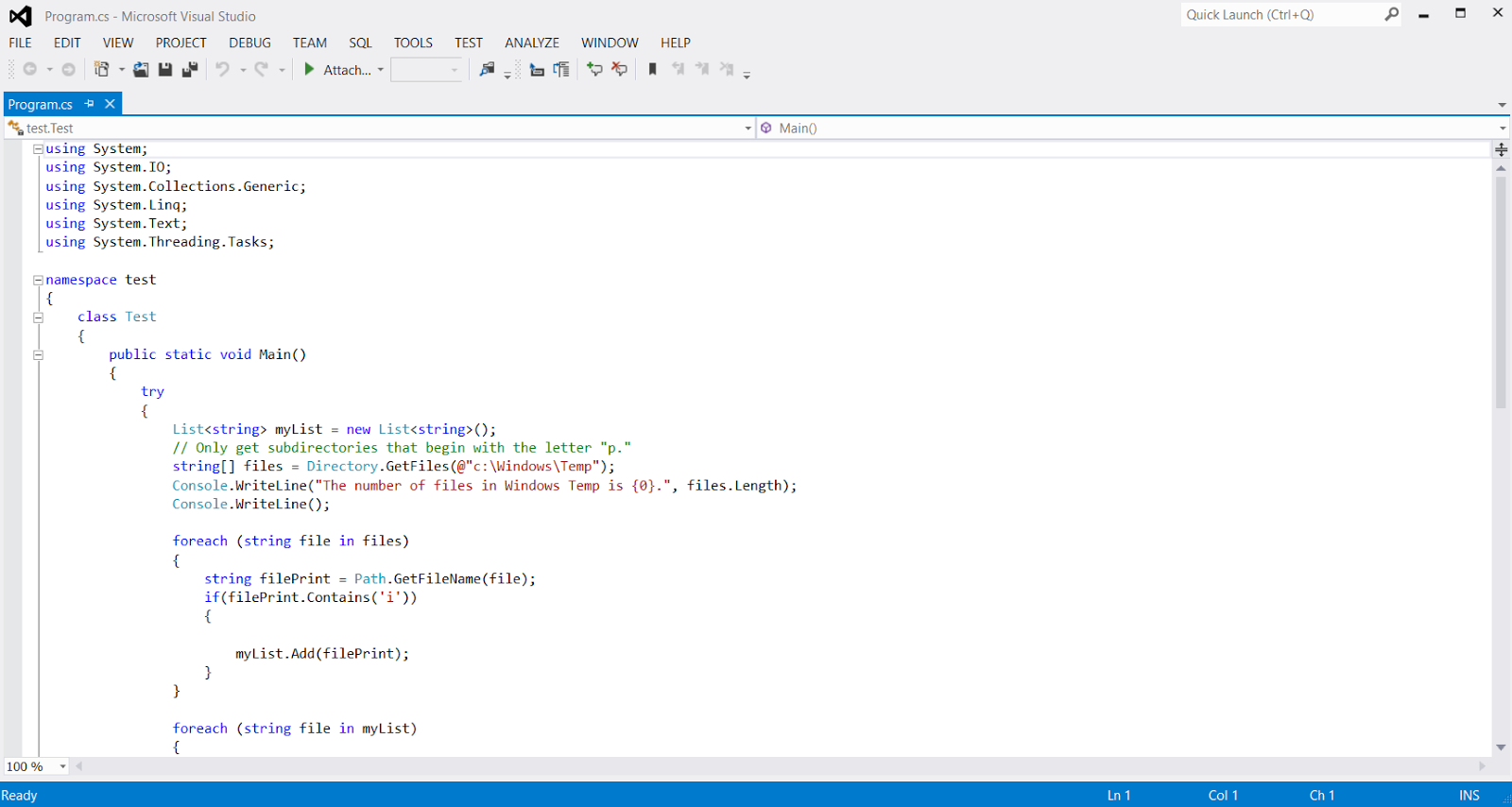
- My most recent project with my mentor

1.  Describe in detail what you plan to do for your 30 hours.
     - For my allocation of 30 hours, I plan to make a web application that will take the weather for a given area, present the conditions, and suggest outfit plans according to weather conditions. The project is something I've been wanting to do for a long time. Making sure the application works, putting it on a presentable platter, and putting it on a website for other devices to use will take much longer than 30 hours.

2.  Discuss how or what you will do to meet the expectation of showing 30 hours of evidence.
     - Taking up 30 hours will be no problem. Writing code itself should take about 40 hours if I'm constantly trying to improve. Not only will I have to spend hours writing the program, I'll also need to learn jQuery to put the application on a platform I feel comfortable presenting to other people. I will code during the few free hours I manage between school, work, and college.

3.  Explain how what you will be doing will help you explore your topic in more depth.
     - My topic is application development, this is the perfect way to explore it because it will be what I want it to be from start to finish and if it fails then I will learn why and how to fix it.

4.  Update your Senior Project Hours log.
     - Will do.